Texas vs. Florida Cost of Living in 2026: Which State Is Cheaper?
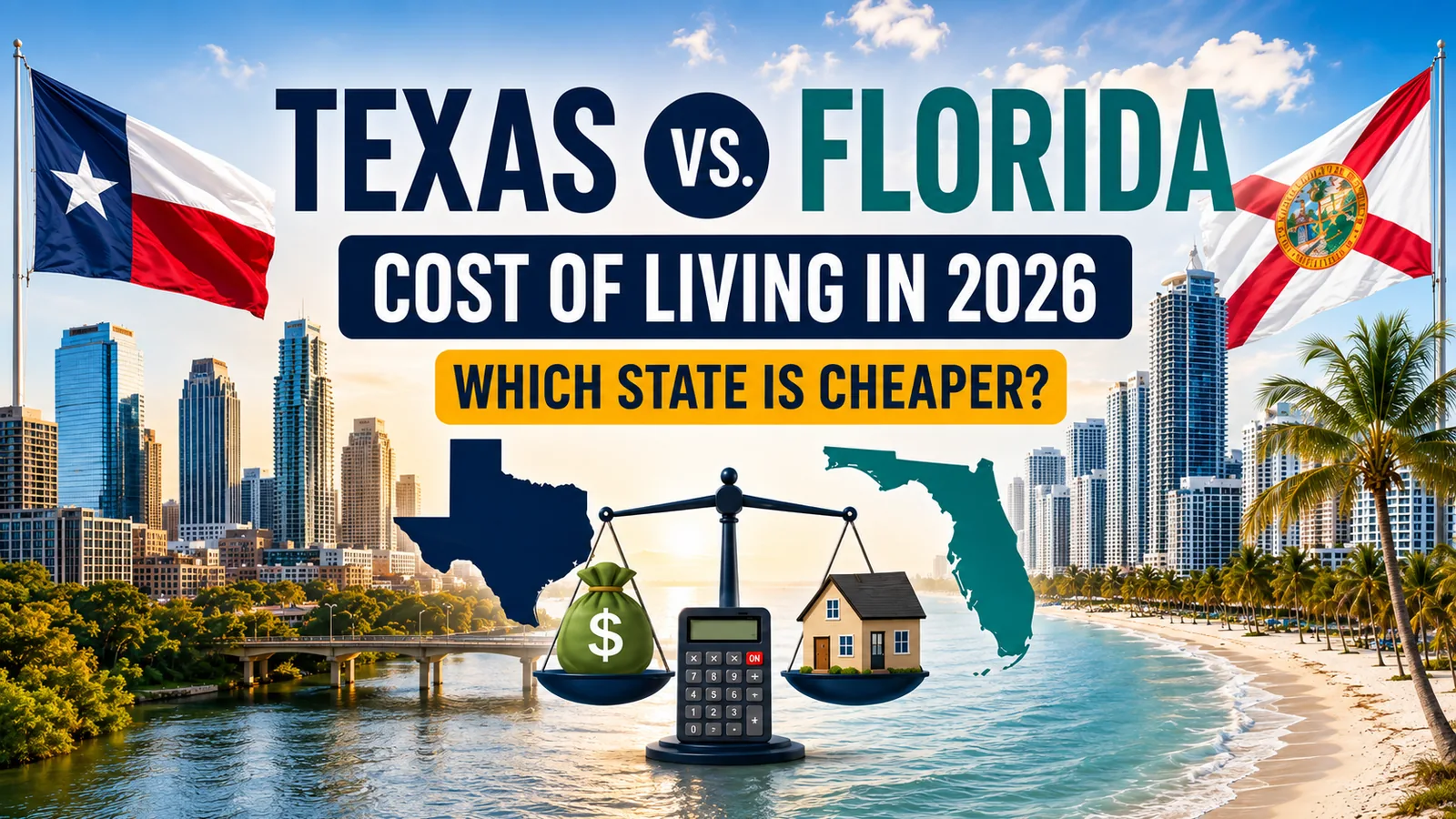
If you’re comparing the Texas vs Florida cost of living in 2026, Texas is generally the cheaper state. Housing is the biggest reason: current home values are lower in Texas, statewide rents are lower in Census data, and the latest official federal price-level data place Texas below Florida overall.
The latest Bureau of Economic Analysis Regional Price Parities put Texas at 97.057 and Florida at 103.414, with the national price level equal to 100. These figures measure 2024 and were released in February 2026. On that official measure, Florida’s overall price level was about 6.5% higher than Texas’s.
That does not mean every expense is lower in Texas. Property taxes are generally higher, homeowners insurance can be expensive in both states, and costs vary substantially between cities and individual properties.
For someone making an actual relocation decision, the useful question is not simply which state is cheaper. It is which combination of housing, taxes, insurance, and income works better for your household. Our Compare Places research takes that broader approach to location comparisons across the United States.
Texas vs. Florida Cost of Living at a Glance
| Measure | Texas | Florida | General Advantage |
|---|---|---|---|
| BEA overall price level, 2024 | 97.057 | 103.414 | Texas |
| BEA housing-rent price level, 2024 | 96.503 | 122.107 | Texas |
| Zillow typical home value, July 2026 | $301,806 | $378,167 | Texas |
| Median gross rent, 2020–2024 | $1,403 | $1,669 | Texas |
| Median household income, 2020–2024 | $78,476 | $74,568 | Texas |
| Effective property tax rate, 2024 | 1.40% | 0.78% | Florida |
| State individual income tax | None | None | Tie |
| State sales tax rate | 6.25% | 6.00% | Florida |
| Average combined state/local sales tax, July 2026 | 8.20% | 6.98% | Florida |
The table uses named datasets rather than combining unrelated estimates into a proprietary “2026 cost-of-living index.” BEA’s 2024 Regional Price Parities are the latest official annual figures available as of August 2026; the next release is scheduled for December 10, 2026.
Is Texas or Florida Cheaper Overall?
Texas is cheaper overall based on the latest official state price-level data.
BEA’s Regional Price Parities measure how prices in an area compare with the national price level. An index of 100 represents the national level. Texas’s 2024 RPP was 97.057, while Florida’s was 103.414.
The housing component shows an even larger difference.
BEA’s housing-rent RPP was 96.503 for Texas and 122.107 for Florida. Compared directly, Florida’s housing-rent price level was roughly 26.5% higher on this measure.
That housing gap explains much of Texas’s overall cost advantage and is consistent with current home-value and rent data.
For a broader explanation of how location-based expenses are measured, see our Cost of Living research.
Housing Costs: Texas vs. Florida
Housing is the clearest financial distinction between Texas and Florida, especially for people deciding where to buy or rent.
Home Prices
Zillow’s July 31, 2026 home value data put the typical Texas home value at $301,806, compared with $378,167 in Florida.
Using the same Zillow measure, Florida’s typical home value is roughly 25% higher.
Both states have also experienced some recent price softening. Texas home values were down 1.8% year over year, while Florida values were down 2.2%.
A lower home price can reduce more than the amount needed for a down payment. It can also lower the amount financed and the total interest paid over the life of the mortgage.
But home price alone is not the same thing as housing affordability. Mortgage rates, household income, taxes, insurance, and recurring ownership expenses all determine whether a particular home is affordable.
For another state-level affordability lens, see our Home Price-to-Income Ratio by State in 2026.
Rent
Texas also has the advantage in the latest Census statewide estimates.
Median gross rent for 2020–2024 was:
- Texas: $1,403
- Florida: $1,669
Florida’s figure is about 19% higher.
These Census figures do not reflect August 2026 asking rents. They are five-year American Community Survey estimates and should not be interpreted as the current advertised rent for a particular apartment.
They are useful, however, because they provide a consistent statewide comparison. Their direction also agrees with BEA’s much larger housing-rent price-level gap.
For renters who have not yet selected a particular city, Texas has the stronger statewide affordability case.
Why Statewide Housing Averages Can Mislead
Neither Texas nor Florida is a single housing market.
Austin can produce a very different affordability calculation from San Antonio or Houston. In Florida, Miami and other parts of South Florida can differ substantially from Jacksonville, Tampa, Orlando, or inland markets.
The same is true for rents, insurance premiums, and property taxes.
That means statewide comparisons are most useful as a first screening tool. Once you narrow the decision to specific metros or cities, local housing costs become more important than the state average.
Market leverage can vary just as much at the metro level. Our Best Buyer’s Markets in the U.S. in 2026 includes Miami and several major Texas metros.
Property Taxes: Florida Has the Advantage
Housing purchase prices favor Texas, but property taxes favor Florida.
Tax Foundation’s 2026 comparison, using 2024 Census data, puts property taxes paid as a percentage of owner-occupied housing value at:
- Texas: 1.40%
- Florida: 0.78%
That is an important difference and one reason buyers should not compare the two states on home prices alone.
A less expensive Texas home can still carry a relatively high property tax bill. Conversely, a more expensive Florida property may have a lower effective tax rate.
Actual property taxes are local, however. Counties, cities, school districts, and other taxing authorities can affect the final bill, along with exemptions and the property’s assessed value.
Texas law requires school districts to provide a $140,000 residence-homestead exemption for qualifying primary residences. Other taxing units can provide additional exemptions.
Florida has its own homestead protections. Qualifying homestead properties are eligible for the state’s Save Our Homes assessment limitation. For 2026, the annual assessment-growth cap is 2.7%, reflecting the lower of 3% or the applicable change in the Consumer Price Index.
These systems work differently, and neither state’s average effective tax rate can predict the bill for a specific home.
For statewide property tax burden, Florida has the advantage. For an individual purchase, calculate the taxes for the actual property.
Homeowners Insurance Can Change the Calculation
Insurance is one of the most important costs to examine before deciding that a home is affordable.
Texas is not a low-cost homeowners insurance market. The Texas Department of Insurance reports a preliminary statewide average annual homeowners premium of $3,506 for 2025, up from $3,291 in 2024.
Texas insurance costs also vary by location and risk exposure. The Texas Department of Insurance publishes county-level premium information and notes that coastal properties may require separate wind coverage through the Texas Windstorm Insurance Association in eligible areas.
Florida has its own location-sensitive insurance challenges, particularly in areas exposed to hurricanes, wind, and coastal hazards. A homeowner’s actual premium can differ substantially based on the property, location, insured value, deductible, construction characteristics, and insurer.
That makes insurance one of the areas where statewide cost comparisons become less useful.
A relatively inexpensive house can become much less affordable once homeowners insurance, flood coverage where needed, property taxes, and other recurring expenses are included.
This is where the cost of living overlaps with Housing Risk & Resilience. The price of buying a home is only one part of its long-term cost.
For a broader state-by-state comparison of these recurring ownership costs, see our Home Insurance vs Property Taxes by State in 2026.
Income Taxes and Sales Taxes
Texas and Florida have one major tax characteristic in common. Neither state imposes an individual state income tax.
That means state individual income tax is not a meaningful differentiator for a typical wage earner comparing the two states. Sales taxes are different.
Texas has a 6.25% state sales tax. Local jurisdictions can add up to another 2%, producing a maximum combined rate of 8.25%.
Florida’s state sales tax is 6%, with local surtaxes applying in many counties.
Tax Foundation’s July 2026 comparison estimates the average combined state and local rate at:
- Texas: 8.20%
- Florida: 6.98%
So the major tax comparison looks like this:
- State individual income tax: tie
- Effective property-tax rate: Florida generally lower
- Average combined sales-tax rate: Florida lower
- Typical home value: Texas lower
This is why simply describing one state as “low tax” does not tell a household which state will cost less overall.
Income and Purchasing Power
Costs become more meaningful when considered alongside income.
Census QuickFacts reports median household income for 2020–2024, in 2024 dollars, at:
- Texas: $78,476
- Florida: $74,568
Texas’s median household income is about 5% higher on this measure, while its overall BEA price level is lower.
That combination strengthens Texas’s statewide purchasing-power case.
It does not mean every occupation pays more in Texas. Salaries vary between industries and metropolitan areas, and someone relocating while keeping the same remote salary faces a different calculation from someone whose compensation changes after moving.
A practical comparison therefore needs to answer two questions:
- What income will you actually have after moving?
- What will your specific housing arrangement cost?
State averages are a starting point for that calculation, not the household budget itself.
Housing-Cost Statistic That Needs Context
One Census statistic appears surprising when viewed alongside lower Texas home values.
For 2020–2024, the median selected monthly owner costs for homeowners with a mortgage were:
- Texas: $2,106
- Florida: $1,959
That does not mean it currently costs more to buy the typical Texas home.
The Census measure covers more than mortgage principal and interest. Selected monthly owner costs can incorporate items such as real estate taxes, insurance, utilities, and other housing expenses. It is also a historical five-year estimate rather than the expected monthly cost for someone purchasing a home in August 2026.
The figure nevertheless reinforces an important point:
A cheaper house does not automatically mean cheaper total homeownership.
Texas’s higher property tax burden and insurance costs can narrow part of the advantage created by lower purchase prices.
Which State Is Cheaper for Renters?
Texas has the stronger statewide case for renters. Two separate federal measures point in the same direction.
Census median gross rent is $1,403 in Texas versus $1,669 in Florida, while BEA’s housing-rent price-level measure also places Texas well below Florida.
Renters also avoid directly paying a homeowner’s property-tax and insurance bills, although those costs can ultimately influence rents.
If minimizing housing expense is the primary goal and you remain flexible about the specific city, Texas generally offers the better statewide starting point for renters.
Which State Is Cheaper for Homeowners?
For someone purchasing a home today, Texas generally offers the lower entry price, but the comparison becomes more complicated after the purchase.
Texas generally offers:
- Lower statewide home values
- Higher effective property tax rates
- Significant homeowners insurance costs
- No individual state income tax
Florida generally has:
- Higher statewide home values
- Lower effective property tax rates
- Location-sensitive homeowners insurance costs
- Homestead and Save Our Homes protections for qualifying primary residences
- No individual state income tax
For a new buyer financing a home, Texas’s lower purchase price can be a substantial advantage.
But before choosing between properties, compare the complete monthly ownership cost:
Mortgage principal and interest + property taxes + homeowners insurance + applicable HOA or condo fees + other required coverage.
For long-time Florida homeowners benefiting from Save Our Homes, the cost equation can also look different from that of a new Florida buyer.
There is therefore no responsible statewide claim that every homeowner will spend less in Texas.
Texas vs. Florida: Which Makes More Sense for You?
From a cost perspective, the answer depends on what you are trying to minimize.
| Priority | Stronger General Case |
|---|---|
| Lower statewide cost of living | Texas |
| Lower typical home value | Texas |
| Lower statewide rent | Texas |
| Lower effective property-tax rate | Florida |
| Lower average combined sales-tax rate | Florida |
| No individual state income tax | Tie |
| Higher median household income | Texas |
| Lower homeowners-insurance cost | Depends heavily on location and property |
For renters, Texas is generally easier to justify financially.
For first-time buyers and relocating homebuyers, Texas also starts with a meaningful home-price advantage, but property taxes and insurance need to be added before deciding which property is truly cheaper.
For an established Florida homeowner with favorable homestead treatment, simply comparing current home values can give a misleading picture of what moving would cost.
And for anyone choosing between specific cities, local costs matter far more than the statewide average.
If your decision extends beyond cost alone, our Best States to Live in 2026 compares broader factors including income, employment, education, safety, and health.
If you’re considering an interstate move, our relocation research focuses on the location-specific housing and cost tradeoffs that statewide averages cannot capture.
Is Texas Cheaper Than Florida in 2026?
Yes. The Texas vs Florida cost of living comparison generally favors Texas based on the strongest statewide data currently available. Housing is the biggest reason.
The latest official BEA price data place Texas below Florida overall and show an especially large difference in housing-rent price levels. Zillow’s July 2026 data also put the typical Texas home value at roughly 25% below Florida’s, while Census estimates show lower median gross rent in Texas.
Texas also has a somewhat higher median household income.
Florida’s strongest cost advantage comes from taxes on property and consumption. Its effective property tax rate is substantially lower, its average combined sales tax rate is lower, and, like Texas, it has no individual state income tax.
For homeowners, insurance keeps the comparison from focusing only on home prices and taxes. Costs depend heavily on location, property characteristics, coverage, and risk exposure.
The most accurate conclusion is therefore:
Texas has the lower statewide cost structure, particularly for housing and renters. Florida can be more competitive for some homeowners because of lower property taxes and homestead protections, but higher home values and location-specific insurance costs can offset those advantages.
Once you have narrowed the decision to particular cities or properties, compare them directly rather than relying only on state averages.
Methodology and Data Sources
This comparison uses separate authoritative datasets for the expenses they are designed to measure rather than combining incompatible figures into a single artificial score.
Overall price levels: U.S. Bureau of Economic Analysis Regional Price Parities for 2024, released February 2026.
Current home values: Zillow Home Value Index for Texas and Florida, with data through July 31, 2026.
Rent, household income, and housing costs: U.S. Census Bureau QuickFacts and 2020–2024 American Community Survey estimates.
Property-tax comparison: Tax Foundation’s 2026 state comparison using 2024 Census data.
Texas property-tax rules: Texas Comptroller of Public Accounts.
Florida homestead rules: Florida Department of Revenue.
Sales taxes: Texas Comptroller and Tax Foundation’s July 2026 state and local sales-tax comparison.
Texas homeowners insurance: Texas Department of Insurance.
Different datasets measure different things. A Zillow home value is not the same metric as a Census home value, a BEA Regional Price Parity is not an asking-rent index, and a statewide insurance average is not a quote for an individual property.
The figures in this article were reviewed in August 2026. BEA’s next Regional Price Parities release is scheduled for December 10, 2026.
Frequently Asked Questions
Is Texas cheaper to live in than Florida?
Generally, yes. The Texas vs Florida cost of living data favor Texas overall, particularly for housing and rent. Housing accounts for a substantial part of the difference.
Are houses cheaper in Texas or Florida?
Statewide, Texas is cheaper. Zillow’s July 2026 typical home value is $301,806 in Texas compared with $378,167 in Florida. Individual cities and neighborhoods can differ substantially.
Is rent cheaper in Texas or Florida?
Statewide Census data favor Texas. Median gross rent in the 2020–2024 estimates is $1,403 in Texas and $1,669 in Florida. BEA’s separate housing-rent price-level measure also places Texas considerably below Florida.
Does Texas or Florida have lower property taxes?
Florida generally has the lower effective property tax rate. The Tax Foundation’s 2026 comparison reports an effective rate of 0.78% in Florida versus 1.40% in Texas on owner-occupied housing value, using 2024 data. Actual bills depend on local tax rates, assessed values, and exemptions.
Does Texas or Florida have a state income tax?
Neither Texas nor Florida imposes an individual state income tax. Federal income taxes still apply.
Which state has lower sales taxes?
Florida generally has the lower combined rate. As of July 2026, the Tax Foundation estimates the average combined state and local rate at 8.20% in Texas and 6.98% in Florida.
Which state is cheaper for renters?
Texas generally has the stronger statewide case for renters because both Census rent estimates and BEA housing-rent price-level data favor Texas.
Which state is cheaper for homebuyers?
Texas generally offers lower home prices, but the complete answer depends on property taxes, insurance, and the specific property. Florida has a lower effective property-tax rate, while insurance costs in both states can vary substantially by location.
Is Texas or Florida better if my main goal is saving money?
If minimizing statewide living and housing costs is the main goal, Texas generally has the advantage. A household choosing between specific cities or homes should still compare local housing, taxes, insurance, and expected income before making a final decision.