
Housing Affordability Explained: Costs, Income, and Comparisons
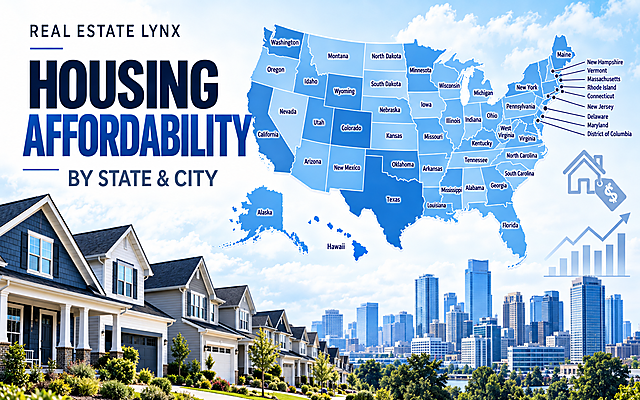
Housing affordability is not simply about finding the lowest home price or monthly rent. A home is affordable when its upfront and ongoing costs fit a household’s income, essential expenses, financial reserves, and longer-term needs. That calculation can change considerably from one state, metro area, city, or neighborhood to another.
To judge whether a place is affordable, compare housing expenses with income, available savings, and the costs specific to that home. The discussion below explains renting and owning, measurement limits, and comparisons between states, metro areas, cities, and neighborhoods. For expenses beyond housing, see Cost of Living & Affordability.
What Does Housing Affordability Mean?
Housing affordability describes the relationship between the cost of having a place to live and the resources available to pay for it. The relevant question is not only, “Can I make the payment?” It is also, “Can I make the payment consistently without sacrificing other necessities or exhausting my emergency savings?”
For a renter, that means looking beyond the advertised rent to utilities, required fees, transportation, possible renewal increases, and the income remaining after other obligations. For a buyer, it includes the down payment and closing costs, mortgage payments, property taxes, insurance, maintenance, and the cash needed for unexpected repairs.
Affordability is both a market-level research question and a personal budgeting question. Researchers compare prices, rents, and income across places. Households need the next layer of detail: a specific home, actual insurance and utility estimates, their financing terms, their income stability, and their priorities. A state with relatively inexpensive homes can still be difficult to afford when local earnings are low or recurring ownership costs are high.
How Home Prices and Mortgage Rates Affect Affordability
A home price is an important starting point, but two people buying homes at the same price can face different monthly payments. Their down payments, interest rates, loan terms, taxes, insurance premiums, and association dues may all differ. Likewise, a market’s median sale price is not a substitute for a payment estimate for an actual property.
Prices also change with local demand and supply. The U.S. Housing Markets guide provides broader context for the market conditions behind those prices. When comparing homes, use recent, comparable property prices and separate the purchase price from the amount you will need to borrow.
Mortgage rates are especially important because they determine how expensive financing becomes. A higher rate generally increases monthly principal and interest for the same loan amount. A lower rate can improve borrowing capacity, although additional buyer demand may offset some benefits by putting pressure on prices. An existing owner who has a substantially lower fixed rate may be reluctant to move, a pattern examined in Mortgage Rate Lock-In Effect in 2026.
Look at the Full Monthly Ownership Payment
Principal and interest are only part of the recurring cost. Property taxes, homeowners insurance, mortgage insurance when applicable, and HOA dues may add hundreds of dollars to the monthly obligation. Utilities and maintenance also matter to a household’s actual budget, even if they are not all included in the lender’s quoted monthly payment.
For a useful comparison, check whether the lender’s estimate shows only principal and interest or a total payment that already includes escrowed property taxes, homeowners insurance, and any mortgage insurance. Add only costs not already included, such as separately paid insurance, HOA dues, or taxes paid outside escrow. Then budget for utilities and maintenance as household expenses, not as mortgage-payment components. Identify which amounts are estimates and which may change. This avoids counting the same charge twice.
If you are considering a home in a higher-tax area, our high property tax states guide explains why the seller’s bill may differ from a buyer’s estimated taxes and how property-tax escrow can affect the projected monthly payment.
Down Payments, Closing Costs, and Cash Reserves
A larger down payment reduces the mortgage balance and may lower financing or mortgage-insurance costs. But using nearly all available savings for the down payment can leave a new homeowner exposed to moving costs, repairs, and income interruptions.
The amount due at settlement may include the down payment, lender and settlement charges, and applicable prepaid taxes or insurance, adjusted for any deposits and credits already paid. Moving expenses, furnishings, immediate repairs, and emergency reserves are separate cash needs around move-in, not necessarily closing charges.
Review the lender’s estimate of cash to close, then calculate the additional amount you need to settle in without exhausting savings. A lender’s minimum down payment and the amount you can prudently commit are not necessarily the same.
Income, Affordability Ratios, and Housing Cost Burden
The same housing cost can be manageable for one household and financially restrictive for another. Income level, income stability, existing debt, dependents, transportation needs, and savings goals all affect the answer.
Income comparisons are especially useful when studying different regions because a low-price market may also have low wages. For a statewide baseline, consult Median Household Income by State.
Price-to-Income Ratios
A price-to-income ratio compares a typical home price with a defined annual income measure. For example, a $360,000 home divided by $90,000 in annual household income gives a ratio of 4.0. The ratio is useful for comparing broad market conditions, not for determining whether a specific household qualifies for or can comfortably pay a mortgage.
It leaves out the interest rate, down payment, local taxes, insurance, other debts, and many recurring costs. It also matters whether the home price represents a median sold home, a listed home, or some other measure, and whether the income figure covers the same location and period.
Home Price-to-Income Ratio by State in 2026 explores that relationship across states using a consistent comparison framework.
Rent-to-Income Ratios
Rent-to-income ratios compare rent with income over the same period. For a clearly defined housing-cost measure, housing-cost-to-income ratio (%) = monthly housing costs ÷ gross monthly household income × 100. Include only the expense categories used by the particular method or dataset.
If gross household income is $5,000 per month and rent is $1,500, rent alone equals 30% of gross income. If utilities add $150, rent plus utilities equals $1,650, or 33% of gross income. Mandatory fees may increase the household budget further; they are not automatically part of every published rent measure.
Be careful about which rent figure is being used. Advertised asking rents are not interchangeable with the survey-based rents paid by existing households.
The Census 2024 American Community Survey (ACS) 1-year Table B25070 reports gross rent as a percentage of household income for renter-occupied homes. Its definition and 2024 reporting period matter when interpreting a current market comparison.
What Counts as Housing Cost Burden?
Under HUD’s Comprehensive Housing Affordability Strategy (CHAS) definitions, households spending more than 30% of monthly income on housing costs, including utilities, are classified as cost burdened. Spending more than 50% is classified as severely cost burdened.
These are statistical categories for describing housing pressure. They are not individualized spending targets or automatic mortgage approval limits.
For owners, cost measures and reporting populations differ from the renter measures. The Census 2024 ACS 1-year Table B25091 reports selected monthly owner costs as a percentage of household income, distinguishing homes with and without a mortgage. A lender’s quoted payment, a household’s comprehensive monthly budget, and a Census owner-cost ratio may cover different items.
A high cost burden may leave less money for food, childcare, healthcare, transportation, and emergency savings. But households with the same percentage can have very different financial capacity because their remaining income and necessary expenses differ. Housing Cost Burden by State in 2026 offers the separate state-by-state analysis.
Two Illustrative Household Budgets
These examples are hypothetical and show how to think through expenses. They are not current market quotes, mortgage offers, or affordability thresholds.
Renter example: A household earns $5,000 in gross monthly income. Its rent is $1,500 and utilities average $150. The $1,650 rent-and-utilities total equals 33% of gross income. Renters insurance, parking, and commuting may raise what the household spends each month. The next test is whether enough take-home pay remains after taxes and other essential obligations.
Buyer example: A $350,000 home with a 10% down payment would have a $315,000 loan before financed fees. At an illustrative 6.5% fixed rate over 30 years, principal and interest would be approximately $1,991 a month.
For this example only, assume separate monthly estimates of $360 for property taxes, $165 for homeowners insurance, and $125 for mortgage insurance. The resulting $2,641 combines these components once, regardless of whether the lender collects some of them through escrow.
The $125 mortgage-insurance assumption is not a typical quote: availability and cost vary by loan program, credit profile, down payment, and other terms. Add $220 for utilities and a $275 repair reserve, and the wider household housing budget becomes about $3,136, excluding any HOA dues. These figures are hypothetical, not current loan offers or property quotes.
The useful lesson is that one headline number is rarely enough. Compare a market ratio, a property-level payment estimate, and your personal cash flow separately rather than treating them as the same measurement.
Renting Versus Buying: Compare the Whole Cost
Renting and owning create different financial commitments. Renting usually avoids a large down payment and transfers many building repairs to the owner, but a renter may face lease renewal increases, restrictions, or moving costs.
Buying may provide housing-payment stability on a fixed-rate loan and potential equity accumulation, but it also brings transaction costs, ongoing maintenance, and exposure to changes in property taxes and insurance.
For renting, start with actual advertised rent for the home type and location you need. Add mandatory fees, utilities not included in rent, renters insurance, parking, and expected transportation costs. Then examine lease terms and how a realistic renewal increase would affect your budget.
State-level rents offer a starting benchmark, but they do not replace neighborhood-specific listings; see Average Rent by State in 2026 for one consistent comparison.
For buying, calculate cash required before move-in and the recurring cost after move-in. Include property taxes based on the actual home and any likely reassessment, rather than assuming the current owner’s tax bill will remain unchanged.
Effective state averages, explained in Property Tax Rates by State in 2026 ranking, cannot determine the tax bill for a particular address.
For a practical homebuyer shortlist, our low property tax states guide shows how to compare actual property-tax records, exemptions, insurance and the full monthly cost of two homes.
Insurance deserves equal attention. Premiums and insurer availability can vary with geography, building characteristics, exposure to storms, flooding or wildfire, and claims history. Home Insurance vs Property Taxes by State in 2026 shows why these two expenses should be considered separately.
Flood coverage may require an additional policy, and mortgage or local requirements can affect which insurance must be carried. For the broader relationship between exposure, insurance, and housing decisions, visit Housing Risk & Resilience.
HOA dues, special assessments, major repairs, heating and cooling, water, internet, and ordinary maintenance can materially change the total cost of ownership. They deserve real budget entries, not a footnote. A condominium with lower maintenance responsibility may still have significant association dues; a detached property without dues may require more direct spending on repairs and upkeep.
A rent-versus-buy decision also depends on how long you expect to stay, the flexibility you need, cash reserves, and the costs of buying and later selling. No single price-to-rent ratio proves that everyone should buy or rent. The right comparison uses equivalent property types, a consistent location, clearly stated financing assumptions, and realistic holding periods.
Why a Cheaper Home Does Not Always Mean a Cheaper Life
A lower rent or mortgage can be offset by higher commuting expenses. For example, a hypothetical $250 monthly housing saving may disappear if a longer drive requires substantially more fuel, tolls, or parking.
Compare the full budget while keeping commuting costs separate from statistical housing-cost-burden measures. Cost of Living addresses the wider household spending picture.
Employment, Wages, and Housing Supply
Strong local job growth can support incomes, but it can also increase demand for homes. If available housing does not keep pace, higher earnings may coexist with rising prices or rents.
Housing conditions therefore need to be interpreted alongside employment trends and new construction, not only household income. The Housing Economy guide covers the economic side of these changes.
Construction, zoning, land availability, infrastructure, financing, and development lead times can affect how quickly a market can add housing. Low for-sale inventory may give buyers fewer choices and reduce their negotiating leverage.
Greater inventory can help, but not every additional property suits first-time buyers or renters with tighter budgets. Best Buyer’s Markets in the U.S. in 2026 examines conditions under which purchasers have more room to negotiate.
Fast population growth can increase demand before enough homes are built. The effect depends on existing supply, household formation, employment, and the kinds of housing constructed.
Fast-Growing Affordable Metros in the U.S. for 2026 examines places where growth and comparatively moderate values overlap; that is different from saying every home in those metros is affordable to every resident.
Migration and Household Decisions
A move from an expensive metro to a lower-priced one may improve a household’s housing budget, but only if income, job arrangements, healthcare access, transportation, taxes, and other obligations still work.
Housing costs may also change after relocation as demand responds to arrivals and construction. Where Americans Are Moving in 2026 supplies state-to-state context, while U.S. Migration Trends covers migration patterns more broadly.
Moving for lower costs can be sensible, but consider the full transition: the cost of moving, the loss or gain of local support, commute patterns, school or caregiving arrangements, and financial flexibility after arrival. A cheaper property is not a better fit if the new household budget becomes less resilient.
Housing Affordability by State, Metro, City, and Neighborhood
A national or statewide median can describe a pattern without describing the property available to you. Major metros, small towns, and rural areas within one state may have very different incomes, inventory, taxes, commuting options, and home prices.
Ownership rates also should not be confused with affordability: Homeownership Rate by State in 2026 describes how many households own, not whether a new buyer can afford a home today.
State level: Use consistent statewide measures to understand broad differences in housing prices, rent, earnings, taxes, insurance, and household cost burden. The U.S. States directory provides entry points for more detailed state research. State averages are screening tools, not purchase budgets.
Metro and city level: Compare where people actually work and search for housing, recognizing that metro boundaries often include several cities and suburbs. Review local wage opportunities and the kind of housing represented by the price or rent estimate. U.S. Cities & Metro Areas helps organize this more granular research.
Neighborhood and property level: Narrow the analysis to the particular home type, address, commuting pattern, school or care needs, local insurance market, and property condition. Two neighborhoods within the same city can create significantly different costs. The Neighborhoods section offers the next layer of place-based research.
For any of these comparisons, verify whether the source covers sold homes, listed homes, asking rents, occupied-unit rents, median income, or another measure. Do not combine numbers from different years or geographies as though they were directly comparable.
How to Compare Housing Affordability Between Two Places
A good comparison begins with the same household and the same assumptions, then changes the location. Before choosing a destination, follow these four steps.
- Use matching geography and data periods. Compare metros with metros or cities with cities. Record the housing type and the month or year for every price, rent, and income estimate.
- Estimate the same type of housing in each location. A one-bedroom apartment should not be compared with a three-bedroom house without acknowledging the difference. For buyers, state the down payment, rate, loan term, and property taxes used.
- Build an all-in monthly budget. Include rent or mortgage costs, taxes, insurance, mandatory fees, utilities, maintenance where appropriate, and transportation. Compare these outlays with actual household income after accounting for essential expenses.
- Stress-test the decision. Consider a rent increase, higher insurance renewal, emergency repair, changed commute, or a period of lower income. Ask whether sufficient savings and flexibility remain.
Consider a hypothetical household choosing between Area A and Area B. The figures below are illustrative monthly amounts for a renter, not measurements of any actual city. The combined amount is a housing-plus-transportation budget, not a HUD housing-cost-burden statistic.
| Monthly item | Area A | Area B |
|---|---|---|
| Rent and mandatory housing fees | $1,650 | $1,400 |
| Utilities | $160 | $190 |
| Transportation | $180 | $520 |
| Housing + utilities + transport | $1,990 | $2,110 |
Area B has the lower rent but the higher combined outlay in this example. The calculation does not decide where to move; it illustrates why a cheaper advertised rent may not produce an affordable lifestyle. Household income, time spent commuting, neighborhood suitability, services, and future changes still matter.
For an ownership-focused comparison, Rent vs. Buy by State in 2026: Price-to-Rent Ratios for All 50 States supplies state-level price-to-rent context. For broader side-by-side destination research, use Compare Places.
A ranking of Cheapest States to Live in 2026 describes overall price levels, whereas housing affordability asks whether housing costs are manageable relative to household resources. The Best Places to Live collection considers wider location choices rather than housing cost alone.
Housing Affordability for Different Households
First-Time Buyers
First-time buyers often need to manage savings for a down payment and closing costs while preparing for expenses that were previously included in rent.
Compare what the lender may approve with what still leaves room for repairs, furnishing, transportation, and emergency savings. Entry-level inventory can be limited, but stretching to the maximum available mortgage may reduce financial flexibility.
Existing Homeowners
A household with a low fixed mortgage rate may find its present home manageable even when buying a similarly priced replacement would be more expensive. Moving can also trigger a new tax assessment, higher insurance expenses, and transaction costs.
Mortgage Rate Lock-In Effect provides further background on why owners may delay moving. The decision should compare the actual cost of staying with the realistic cost of relocating, not just sale prices.
Renters, Families, Retirees, and Remote Workers
Renters should examine renewal terms and the availability of alternatives nearby, especially where vacancies are limited. Families need to account for childcare, schools, commuting, household size, and access to healthcare.
Retirees may be particularly exposed to increases in recurring costs when income is relatively fixed. Remote workers should confirm employer policies, tax implications, suitable workspace, and connectivity before assuming a lower-price destination will be practical.
Different households may reasonably choose different housing budgets in the same market. Comparing the actual costs and constraints helps reveal those trade-offs without imposing a universal threshold.
A Practical Housing Budget: Qualification Is Not the Same as Comfort
The familiar 30% housing benchmark is useful for describing cost burden, but it does not determine whether your particular household will feel financially secure. A household with high childcare expenses, medical needs, unstable income, or significant debt may need substantially more room in its budget. Another with different obligations may have greater flexibility.
Mortgage qualification is a separate decision made under a lender’s underwriting rules. The amount a lender is willing to finance may exceed the amount a household wishes to spend. The Consumer Financial Protection Bureau’s homebuying budget guidance emphasizes evaluating the total ownership payment, other obligations, savings, and cash needed for maintenance and emergencies.
Before signing a lease or purchasing a home, try this checklist:
- Determine reliable monthly take-home income and identify obligations that cannot easily be reduced.
- Obtain property-specific rent or loan terms, taxes, insurance, utilities, and mandatory fees.
- Set aside a realistic amount for maintenance if you will own the property.
- Include commuting, caregiving, and other expenses that change with location.
- Confirm the upfront cash required and the reserves that will remain afterward.
- Test how your budget would respond if an important cost rises or income falls.
Financial pressure can affect household stability and the ability to make ordinary plans. The goal is not to eliminate every possible risk. It is to avoid selecting a housing cost that leaves no practical margin for essential commitments, emergencies, or future changes.
Housing Affordability Data: What the Numbers Can and Cannot Tell You
Housing affordability research draws on the U.S. Census Bureau, the American Community Survey, HUD, federal housing and labor agencies, and reliable local data sources. Each measure answers a different question.
A reported median home price cannot tell you what a particular property’s insurance will cost. A Census cost-burden rate does not tell you the asking rent for a newly listed apartment. A state-level price-to-income ratio is not a lender’s debt-to-income calculation.
When using a statistic, check the geographic coverage, population, housing type, reporting period, definition of income, and whether expenses include utilities or other fees.
The cited 2024 ACS 1-year tables are survey measures for 2024 and should not be described as current 2026 listings. A one-year ACS estimate and a five-year ACS estimate also have different measurement properties and should not be casually mixed.
The distinction between a broad measure and a personal quote is especially important for insurance, taxes, mortgage rates, and maintenance. Always confirm address-specific details before making a financial commitment. See the Editorial Policy for how data sources, corrections, and research methods are handled.
Frequently Asked Questions About Housing Affordability
Is housing affordable if it costs less than 30% of my income?
Not automatically. A cost-to-income ratio below 30% is not a personalized budget approval. Check recurring necessities, income volatility, and whether emergency reserves remain intact after paying housing costs.
Is a lower home price always better for affordability?
No. Compare total monthly ownership cost and upfront cash at the property level. A cheaper home may have higher taxes, insurance, needed repairs, or travel costs; compare actual quotes before choosing.
Should I use median rent or advertised rent to compare cities?
For a planned move, start with recent asking rents for comparable available units. Use survey medians to understand existing renters. Do not treat these as interchangeable, and check whether utilities and fees are included.
Can I compare housing affordability using statewide averages alone?
State averages can narrow a search, but not determine the cost of an individual home. Compare metro and neighborhood figures, then verify taxes, insurance, rental terms or financing for the actual address.
What matters most when deciding whether to rent or buy?
Start with how long you expect to remain, available cash after moving, and the complete cost of each option. Account for ownership transaction costs, repairs and property risks alongside lease flexibility and renewal uncertainty. A ratio alone cannot make that decision.
Featured Housing Affordability Research
For more detailed comparisons, start with these published studies:
- Home Price-to-Income Ratio by State 2026 examines housing prices relative to income across states.
- Home Insurance vs Property Taxes by State 2026 compares two substantial recurring ownership expenses.
- Mortgage Rate Lock-In Effect in 2026 explains how existing mortgage rates can affect mobility and turnover.
- Best Buyer’s Markets in the U.S. in 2026 examines market conditions that may improve buyer leverage.
- Fast-Growing Affordable Metros in the U.S. for 2026 explores the overlap between population growth and comparatively moderate home values.
Explore Related Research
Housing affordability is connected to the market, place, economy, risk, and relocation decisions behind a household’s budget. Explore these broader research collections:
- U.S. Housing Markets for sale and inventory conditions.
- U.S. States for statewide research.
- U.S. Cities & Metro Areas for metro and city analysis.
- Neighborhoods for more localized context.
- Cost of Living for costs beyond housing.
- Compare Places for side-by-side location research.
- Best Places to Live for broader place comparisons.
- Relocation for the practical considerations of moving.
- U.S. Migration Trends for population movement.
- Housing Risk & Resilience for physical and insurance-related exposure.
- Housing Economy for employment, supply, and broader market forces.
A useful housing decision does not depend on one ranking or a single affordability ratio. Begin with reliable measures, connect them to the actual home and location, and choose a budget that allows your household to meet its other needs over time.